About the lack of crackpots blaming this on immoral behavior...
although admittedly this guy has nothing on the 700 club. But we all know how quickly the Japanese can play catchup on us.
http://www.guardian.co.uk/world/2011/mar/15/tokyo-governor-tsunami-punishment
Thursday, March 17, 2011


Sunday, March 13, 2011
Always look on the bright side of life
A minor digression to bring you more bad English:
Today was a mercifully warm day all over which will help with the power shortage (heater usage down for sure) - and it prompted me to go for a walk in search of hot dogs and strange English...

Bingo.
And more from the hot springs of Arima:

So true...so almost...
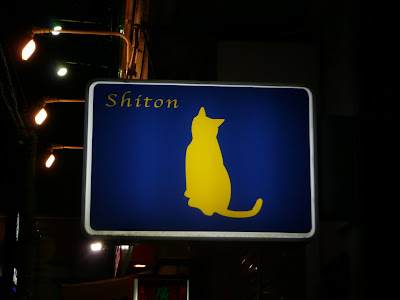
begging the question of on what it is we are to shit? the cat?
Today was a mercifully warm day all over which will help with the power shortage (heater usage down for sure) - and it prompted me to go for a walk in search of hot dogs and strange English...

Bingo.
And more from the hot springs of Arima:

So true...so almost...

begging the question of on what it is we are to shit? the cat?

Saturday, March 12, 2011
In the blink of an eye...
So I was settling down to delve the depths of smug commentary on my home away from home - had the pith helmet and lantern ready to go, when the entire north-eastern coast of Japan decided it would be far more comfortable about 8 feet to the left and rashly decided to get that move over with in three minutes instead of a geologically prudent 7 skazillion years.
This is why we don't do things in a hurry people - ok?
On the other hand, this has been a great endorsement of teamwork, common sense, and Boy Scout motto-thieving.
The death-toll, at this time, is looking like it will pass 1,000 - a horrific number, but mercifully small given the strength of the quake, and the fact that the tsunamis, like an indecisive American patron at a diner, just decided to 'order the menu' by striking 58 of the 47 prefectures in Japan. (side note: In every disaster I can remember being brought to me by CNN over the past 20 years, it always seemed like there were the five or six video clips that got looped again and again - however on this occasion, I have watched about 3 hours of coverage and have yet to see the same footage more than twice - this thing was everywhere). The Hanshin-Awaji Earthquake was over 5,000 dead for a quake that was only 1/250th the strength. Plus this one struck in a location that was (to paraphrase Hitchhikers' Guide) not entirely in, but not entirely away from Tokyo. In other words, this occurred in the 99.9999% of Earth that is in the "not Tokyo" sphere of our Venn diagram, but closer to Tokyo than about 99.996% of other locations in that group. Close enough - and yet, the actual destruction from the shaking was rather minimal. So score one for investing in Earthquake retro-fitting and strict controls on building construction. Furthermore, a nice tsunami warning system told the residents near the ocean to (as politely as possible) get the fuck out of there as fast as their small and efficient cars would take them. So lets just say that that was some tax money well spent. (edit: It was pointed out to me that our Tsuanmi early-warning system is one of the items on the budget chopping block of the new Congress. So good luck with that dipshits)
As for common sense - we were all spared a single utterance by some crack-pot self-proclaimed man of God blaming this on the gays and liberals and universal health care, all while mopping his profusely sweating brow and wondering why images of well-oiled Brad Pitt clones doing naked gymnastics kept flooding through his mind. (Though even Japan isn't safe from RAPDJS - Repetitive and pointing disaster journalist syndrome, typified by some journalist wandering through a a devastated area, emphatically pointing at something that would be improbable outside a disaster zone like a car half-buried in silt, although entirely unsurprising in a location recently tsunamied, all while rattling on like a broken record - "John, John, I just want to point this out...John, can we get this? John, we see a car here, can you get this? This is a car buried by the disaster, are we getting this? this is a car buried in silt. As you can see, the whole car is in silt, which is not how you normally see cars....)
And finally - there is "Be prepared" - this is no joke - People regularly drill for earthquakes as well as tsunamis - children know what to do and where to go. There will be no 'Superdome' type incidents of 10,000 displaced people arriving at some landmark because there was nowhere else to go. There are plenty of emergency shelters (usually just some previously-designated public building, but the 'previously-designated' part of that is immeasurably key) spread around and plenty of signs pointing the way. There were plans for dealing with it. People knew the plans.
People knew where to go and as a result, tens of thousands were likely able to escape. And we didn't have to listen to some bat-shit crazy 'citizen' ramble on about how all this planning was part of some slippery-slope plan by big brother to march us all off to labor camps and weaken our independence and freedoms.
This is why we don't do things in a hurry people - ok?
On the other hand, this has been a great endorsement of teamwork, common sense, and Boy Scout motto-thieving.
The death-toll, at this time, is looking like it will pass 1,000 - a horrific number, but mercifully small given the strength of the quake, and the fact that the tsunamis, like an indecisive American patron at a diner, just decided to 'order the menu' by striking 58 of the 47 prefectures in Japan. (side note: In every disaster I can remember being brought to me by CNN over the past 20 years, it always seemed like there were the five or six video clips that got looped again and again - however on this occasion, I have watched about 3 hours of coverage and have yet to see the same footage more than twice - this thing was everywhere). The Hanshin-Awaji Earthquake was over 5,000 dead for a quake that was only 1/250th the strength. Plus this one struck in a location that was (to paraphrase Hitchhikers' Guide) not entirely in, but not entirely away from Tokyo. In other words, this occurred in the 99.9999% of Earth that is in the "not Tokyo" sphere of our Venn diagram, but closer to Tokyo than about 99.996% of other locations in that group. Close enough - and yet, the actual destruction from the shaking was rather minimal. So score one for investing in Earthquake retro-fitting and strict controls on building construction. Furthermore, a nice tsunami warning system told the residents near the ocean to (as politely as possible) get the fuck out of there as fast as their small and efficient cars would take them. So lets just say that that was some tax money well spent. (edit: It was pointed out to me that our Tsuanmi early-warning system is one of the items on the budget chopping block of the new Congress. So good luck with that dipshits)
As for common sense - we were all spared a single utterance by some crack-pot self-proclaimed man of God blaming this on the gays and liberals and universal health care, all while mopping his profusely sweating brow and wondering why images of well-oiled Brad Pitt clones doing naked gymnastics kept flooding through his mind. (Though even Japan isn't safe from RAPDJS - Repetitive and pointing disaster journalist syndrome, typified by some journalist wandering through a a devastated area, emphatically pointing at something that would be improbable outside a disaster zone like a car half-buried in silt, although entirely unsurprising in a location recently tsunamied, all while rattling on like a broken record - "John, John, I just want to point this out...John, can we get this? John, we see a car here, can you get this? This is a car buried by the disaster, are we getting this? this is a car buried in silt. As you can see, the whole car is in silt, which is not how you normally see cars....)
And finally - there is "Be prepared" - this is no joke - People regularly drill for earthquakes as well as tsunamis - children know what to do and where to go. There will be no 'Superdome' type incidents of 10,000 displaced people arriving at some landmark because there was nowhere else to go. There are plenty of emergency shelters (usually just some previously-designated public building, but the 'previously-designated' part of that is immeasurably key) spread around and plenty of signs pointing the way. There were plans for dealing with it. People knew the plans.
People knew where to go and as a result, tens of thousands were likely able to escape. And we didn't have to listen to some bat-shit crazy 'citizen' ramble on about how all this planning was part of some slippery-slope plan by big brother to march us all off to labor camps and weaken our independence and freedoms.
Thursday, February 24, 2011
How Japan works: part 2 - School (continued)

- Your bold and inquisitive nature won't be considered an asset in about 6 years little boy.
So what is life like at a school in Japan? What kind of classes do the students take? How much homework do they do? What do they eat? When do they go home? What do they learn? How do they behave? What sports do they play? What are the teachers' jobs like? Well, pour yourself a tall glass of listen-up, find a comfortable chair, clear your schedule, hold all calls, put the dog out, and prepare to sacrifice a non-refundable period of time to my subjective ramblings - we are going to answer all those questions before this post is completed (so help me God), and all three of you readers out there become a little bit more likely to kick some serious ass in the "Japanese Educational System" category of Trivial Pursuit: Insanely Obscure Edition.
1) What is life at school like in Japan?
Yes, let us start with a massively vague question. In a word: cold. Or hot. It depends on the season. Japanese schools (except a few newer buildings) do not feature central heating. In fact most of the houses in Japan don't have central heating or cooling. That's why we have Mr. Slim.
Now, there is an up and a down to this. Ecologically speaking, it is admittedly a shameful waste to heat 12 rooms when only one is in use. There is no arguing that localized heating and cooling is an ecological wet-dream. But when this is combined with a total lack of insulation, all those savings are lost as the temperature controlled air flees like a 13 year-old girl's self control at a Justin Bieber concert. All this is to say that the temperature inside school and outside school are about as different as 'Eggshell' and 'Navajo White'. Combine this with a mandatory uniform, which for girls includes a skirt in all seasons, and you have students whose focus is divided between remembering the subjunctive form and maintaining core temperature.
Luckily my school is modern and has central heating, although (and I have no idea why) only in the middle school classrooms. Sorry wee ones, but its another day in the meat locker for you. (I will grant that Japanese children do seem totally immune to cold. Even when allowed to choose their own clothing as they are in elementary school, many skip gaily through the sub-zero winter air with little more than a glorified banana-hammock and a smile.)
2) What kind of classes do they take?
Of course there is PE, math, science, and Japanese. There is also social studies (which goes through middle school and covers some combination of history, civics, sociology, and current events.), art, music, and (thankfully for my job prospects) English - mandatory from grade 5 on.
Classes are 45 minutes in elementary school and 50 in middle school. Class size is usually around 35 to 40 children, though at my school it's more like 15 to 20. Since the school is in a rural part of a large Osaka suburb, there are only that many in each grade including kids bussed in from the other side of the mountains that isolate where I work from the rest of the city.
- if these mountains didn't add 45 minutes to my commute I would be much more appreciative of them
As for the actual educational philosophy;
Japan has been going through constant educational reform as of late. While we wring our hands over the fact that our students think Cosine is the latest Snoop Dogg protege and think the periodic table has to do with menstruation and birth control, the Japanese similarly worry over the difficulty students have with critical thought and writing. Expressing and defending opinions gives many students a lot of trouble since there is no 'right' answer (admittedly American students excel at this - even if it amounts to 'OMG, Dat shit iz totly hott! lol! if you dont like it u r so dum.' - so take that button-down conformist society!). Tests are all fill in the blank and multiple choice - A social studies teacher told me there is no such thing as an essay question on a history test. The famous example is that students who entered Tokyo University (the Harvard of Japan) could tell you everything about the treaty of Ghent (when it was signed, who signed it, where they signed it, what the war was, what the weather on that day was, what they ate after signing it, how many windows were in the room where it was signed, what kind of ink was used, how many words it contained) except its context (why it was signed, what it's signing meant, and how it was connected to and influenced other events of the time). As previously mentioned, getting into High School (and College) is all about passing the entrance exam which is all fill-in-the-blank and multiple choice. There is no interview, letters of recommendation, personal statements, essays, look at extra-curricular activities. Just a straight-up number. Thus 'knowledge' is merely a collection of facts - the more facts, the better. But there is little consideration given to putting those facts into the context of a larger critical world view.
Now - this is not to say that American students are some collection of Oxford-bound whiz-kids who could lucidly pontificate on the subtle differences between the philosophies of Goethe and Nietzsche (and honestly I have no idea if there are any. Or even if those two had any relation other that Teutonicness) Clearly our students could gain a lot from lowering the bong, turning off the cell phone, and learning to express an idea in more than 140 characters.
I'm just saying that those high math scores come with a huge asterisk in the critical analysis department.
And for the record, those educational reforms will go nowhere until the metrics of student assessment and success change.
OK - so 2 of the 2234 topics I raised have been addressed and yet time marches on like some parade of indifference dear reader.
So there will have to be a part three (and let's be honest, probably a four and five)
I leave you with this picture to contrast with the summer vista above - and remember - skirts and no central heat or insulation...

It ended up taking me four hours to get home on this day...
Thursday, February 17, 2011
How Japan works: part 2 - School
This is a topic I should have addressed much earlier seeing as how a spend a large percentage of my waking hours at such an institution, but 1) I actually wanted to have half a clue as to what I was talking about and 2) familiarity breeds contempt so by being in the situation on a daily basis, the ins and outs seemed much more humdrum and unworthy of comment.
Let's put the hypothesis of #2 under the microscope
- it's completely untrue - There is much to note about the school system in Japan. In fact, the school I teach at is such an anomaly in the Japanese public school system that in the 1 year I have been teaching there, we have had visitors from two Korean delegations, 300 members of the ministry of education, 3 Japanese TV crews, 1 German radio crew, and countless regional school boards come for tours. There are two factors that make this school stick out. One is the fact that it is one of only about 4 or 5 public schools in the whole country that are combined elementary and middle schools (more on that in a bit). The other is the that for the past three years the school has been conducting a research program that involved teaching English to all grades (current MOE guidelines dictate mandatory English from grade 5 on). Hence the 300 MOE guests coming to see the end result of the three year program.
But enough about me - how about the system at large?
Public education in Japan begins at preschool. There are 保育園 (Ho'iku'en) which are preschools that are both privately and publicly operated, although both come with a tuition fee. And admittance to either requires a degree of foresight as there is often a waiting list (anyone with a bundle of cash and a desire to run a business could likely make a few yen operating a private preschool here as the demand far outstrips the supply). The monthly fee for a public preschool can be as low as $130 a month, less that the private option, but the real fee is based on the parents' income. (A couple making about 70K USD a year can expect to pay around $600 a month). Such class warfare has amazingly enough not attracted much commentary from Republican commentators in the US who seemingly love using such examples as the obvious horrors that await us following Comrade Obama's eventual Glorious Socialist Revolution.
After preschool comes 幼稚園 (You'chi'en) which is essentially kindergarten (and often called 'kindaagaaten' by the more fashionable institutions over here) For this there is again a private and public option, the key difference with the US being that it covers 3 years (age 3 - 5ish) and the schools are often unconnected to the elementary schools in the area. One of the 'hot trends' for parents with 'more bloody yen that is good for them' is to send a child to an international preschool, which is often (and I speak as a former employee of such a place) staffed by group of borderline alcoholic foreigners whose greatest skill is a passable grasp of the English tongue and a serious desire to get to the bar as soon as 5 o'clock rolls around, as well as a seemingly subconscious desire to impart the concept of dry wit and sarcasm on the youth of Japan. Not that any of MY coworkers were of such ilk.
However, the foreign teacher gig is slowly changing (actually, compared to the rate most things change in Japan, it's proceeding at a pace that would shame most interstellar vehicles) but more on that later - if I remember.
Following a stint at a preschool, it is off to elementary school, where 98% of students put the US to shame when I comes to being unbelievably adorable.
As evidence I offer these pictures of 1st graders participating in 凧揚げ (tako'age, or kite flying)

- My indifference to your camera will defeat your cold heart!

- Our gumboots and random kite themes will strike warmth into your ice-queen visage
Elementary school runs 1st grade to 6th grade where the adorableness quotient is slowly drummed out of them, although very slowly. The big kick is the jump from elementary to middle school. All of a sudden, the days of kite flying and trips to the candy factory (actual field trip at my school) are replaced with uniforms, rote memorization, and unequally distributed puberty. The transition can be brutal, which is why the combined elementary/middle school is so intriguing. One of the biggest problems in Japanese education (as perceived by the Japanese at least) is the difficulty students face in the sudden switch from the halcyon carefree days of 6th grade, and the brutal mind-cram that arrives with your Prussian military-inspired school uniform.
Middle school is giant race for the passing of the 入学試験 (Nyuu'gaku'shiken) or entrance exam. That would be the high school exam.
Yes, while our near-beard spouting bong-toting 14 year old Wunderkinds are guaranteed a spot at the local high school simply because their parents fork over some considerable portion of their hard-earned salary to the local school board, in Japan, no such promises are made.
But before you think that this is like some progressive "right school for the right child" experiment in future-world (or since even public schools charge tuition - a Mitt Romney wet dream of vouchers if you like) you should know that the all the public schools hold their entrance exam on the same day. Which means you can apply to only one. The way this works is that your teacher and parents and you all sit down and look at your grades and decide - this is the public school you can probably get in to.
In short - you can chose one public school and one private school to apply to (private school exams are on a alternate but equally synchronized day) - your reach and your safety with no room for error. (well, some, but more on that tomorrow!)
coming up...part II in our ongoing series on Japanese schools
featuring more pictures, school lunches, and a shocking twist that will have the critics wondering if up has become down!!
Let's put the hypothesis of #2 under the microscope
- it's completely untrue - There is much to note about the school system in Japan. In fact, the school I teach at is such an anomaly in the Japanese public school system that in the 1 year I have been teaching there, we have had visitors from two Korean delegations, 300 members of the ministry of education, 3 Japanese TV crews, 1 German radio crew, and countless regional school boards come for tours. There are two factors that make this school stick out. One is the fact that it is one of only about 4 or 5 public schools in the whole country that are combined elementary and middle schools (more on that in a bit). The other is the that for the past three years the school has been conducting a research program that involved teaching English to all grades (current MOE guidelines dictate mandatory English from grade 5 on). Hence the 300 MOE guests coming to see the end result of the three year program.
But enough about me - how about the system at large?
Public education in Japan begins at preschool. There are 保育園 (Ho'iku'en) which are preschools that are both privately and publicly operated, although both come with a tuition fee. And admittance to either requires a degree of foresight as there is often a waiting list (anyone with a bundle of cash and a desire to run a business could likely make a few yen operating a private preschool here as the demand far outstrips the supply). The monthly fee for a public preschool can be as low as $130 a month, less that the private option, but the real fee is based on the parents' income. (A couple making about 70K USD a year can expect to pay around $600 a month). Such class warfare has amazingly enough not attracted much commentary from Republican commentators in the US who seemingly love using such examples as the obvious horrors that await us following Comrade Obama's eventual Glorious Socialist Revolution.
After preschool comes 幼稚園 (You'chi'en) which is essentially kindergarten (and often called 'kindaagaaten' by the more fashionable institutions over here) For this there is again a private and public option, the key difference with the US being that it covers 3 years (age 3 - 5ish) and the schools are often unconnected to the elementary schools in the area. One of the 'hot trends' for parents with 'more bloody yen that is good for them' is to send a child to an international preschool, which is often (and I speak as a former employee of such a place) staffed by group of borderline alcoholic foreigners whose greatest skill is a passable grasp of the English tongue and a serious desire to get to the bar as soon as 5 o'clock rolls around, as well as a seemingly subconscious desire to impart the concept of dry wit and sarcasm on the youth of Japan. Not that any of MY coworkers were of such ilk.
However, the foreign teacher gig is slowly changing (actually, compared to the rate most things change in Japan, it's proceeding at a pace that would shame most interstellar vehicles) but more on that later - if I remember.
Following a stint at a preschool, it is off to elementary school, where 98% of students put the US to shame when I comes to being unbelievably adorable.
As evidence I offer these pictures of 1st graders participating in 凧揚げ (tako'age, or kite flying)

- My indifference to your camera will defeat your cold heart!

- Our gumboots and random kite themes will strike warmth into your ice-queen visage
Elementary school runs 1st grade to 6th grade where the adorableness quotient is slowly drummed out of them, although very slowly. The big kick is the jump from elementary to middle school. All of a sudden, the days of kite flying and trips to the candy factory (actual field trip at my school) are replaced with uniforms, rote memorization, and unequally distributed puberty. The transition can be brutal, which is why the combined elementary/middle school is so intriguing. One of the biggest problems in Japanese education (as perceived by the Japanese at least) is the difficulty students face in the sudden switch from the halcyon carefree days of 6th grade, and the brutal mind-cram that arrives with your Prussian military-inspired school uniform.
Middle school is giant race for the passing of the 入学試験 (Nyuu'gaku'shiken) or entrance exam. That would be the high school exam.
Yes, while our near-beard spouting bong-toting 14 year old Wunderkinds are guaranteed a spot at the local high school simply because their parents fork over some considerable portion of their hard-earned salary to the local school board, in Japan, no such promises are made.
But before you think that this is like some progressive "right school for the right child" experiment in future-world (or since even public schools charge tuition - a Mitt Romney wet dream of vouchers if you like) you should know that the all the public schools hold their entrance exam on the same day. Which means you can apply to only one. The way this works is that your teacher and parents and you all sit down and look at your grades and decide - this is the public school you can probably get in to.
In short - you can chose one public school and one private school to apply to (private school exams are on a alternate but equally synchronized day) - your reach and your safety with no room for error. (well, some, but more on that tomorrow!)
coming up...part II in our ongoing series on Japanese schools
featuring more pictures, school lunches, and a shocking twist that will have the critics wondering if up has become down!!
Hisahiburi - It's been a while
I will be the first to admit that recently, my updates have been as reliable as a 1960's British sports car, but so goes the way of the blog. Like a neglected hamster, it scorns you and gnaws at your conscience as you while away the hours playing online poker and the latest installment of the Total War series. "I should really post something soon, before I test the concept have actually having a negative number of visitors to my site" you think to yourself as you lose another fake $10,000 to some guy in Hong Kong who beat your straight with a flush you should have suspected, or as Copenhagen falls to your unstoppable but very fictional British forces. So the battle to turn back Napoleon will have to take a hiatus as I renew my efforts to inform you of the insanity, sanity, and weird wonderfulness that is this island, this zen tea garden, this Japan.
Subscribe to:
Posts (Atom)

 Posts
Posts